


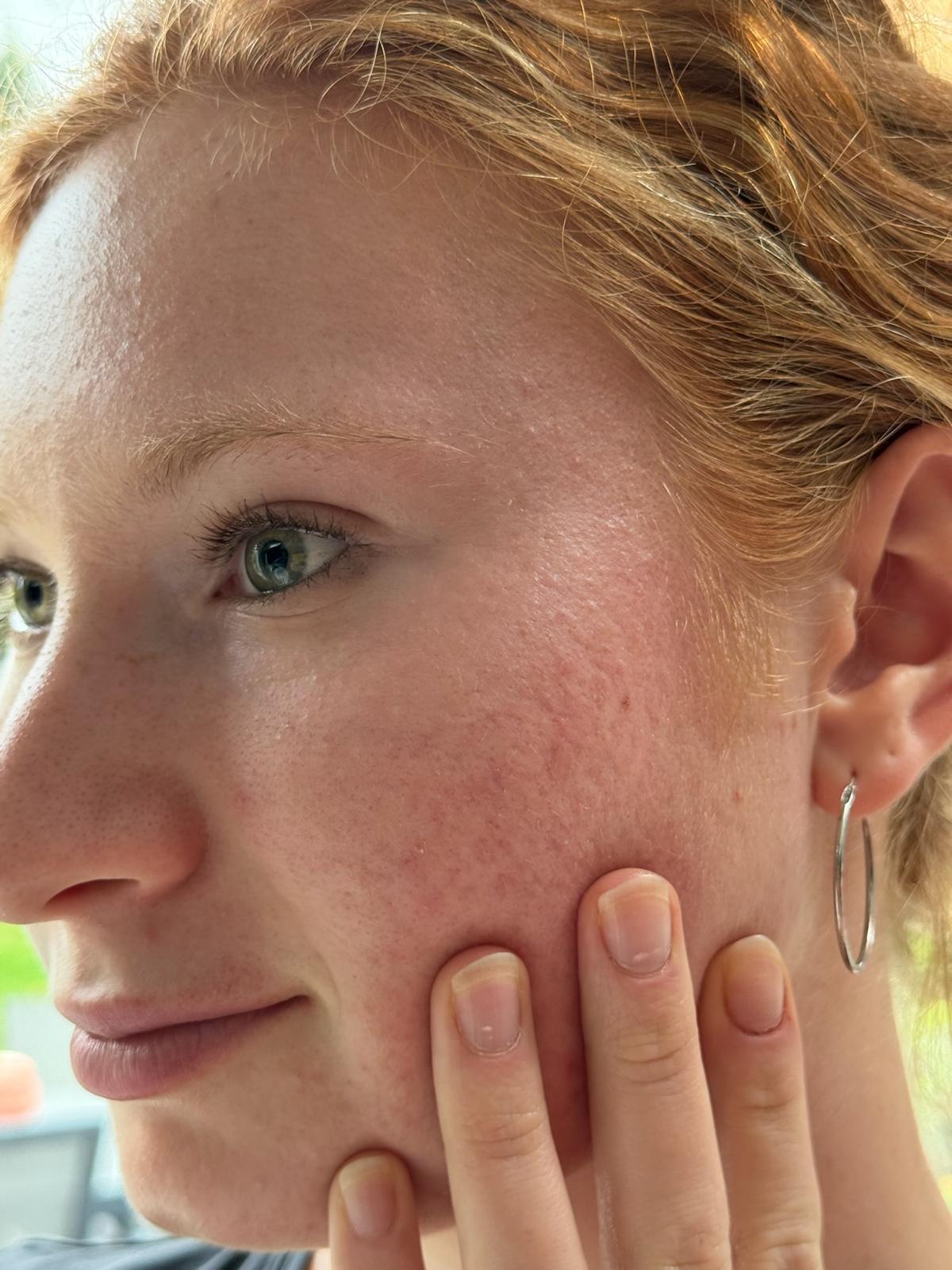
Does your face suddenly sting when you apply a familiar product? You are not alone. A UK study found that 51.4% of women and 38.2% of men described their skin as sensitive, although the research was conducted around High Wycombe rather than nationwide.
What does sensitive skin look and feel like?
Sensitive skin is not one medical diagnosis. It describes skin that reacts more readily to products or its environment. It may look red, dry, flaky or bumpy, but it can also look completely normal. Burning, itching, stinging and tightness are common clues.
Some people are naturally sensitive. Others develop temporarily sensitised skin after over-cleansing, over-exfoliating or using several strong actives. Ageing, hormonal changes, stress, cold weather, low humidity and sun exposure can also influence how skin behaves.
Why is my skin suddenly sensitive?
Often, skin does not need another treatment; it needs fewer products and time to recover.
Think of the skin barrier as a brick wall. Skin cells are the bricks, while lipids including ceramides, cholesterol and fatty acids help form the mortar. When this barrier is disrupted, moisture escapes more easily and irritants can penetrate more readily.
Do we really apply 168 chemicals every day?
You may have seen the claim that women put 168 chemicals on their faces daily. That is not quite accurate.
The figure came from a 2004 Environmental Working Group survey, which estimated that women used 12 personal-care products containing 168 unique ingredients each day. Those products included skincare, makeup, haircare, fragrance and body care not only products applied to the face.
Layering multiple formulas increases the number of potential irritants your skin encounters. It also makes it much harder to identify the culprit when burning, dryness or redness appears. For sensitive skin, simplicity is sensible.
Which skincare ingredients may irritate sensitive skin?
No ingredient irritates everyone; concentration and formulation matter. However, some ingredients deserve extra attention:
- Sodium lauryl sulphate: A strong cleansing surfactant that may strip oils and cause irritation.
- Fragrance: A recognised contact allergen. Natural fragrance and essential oils can also contain fragrance allergens.
- Alcohol denat: This can sting or feel drying when used at higher concentrations.
- Preservatives: These prevent microbial growth and are essential for product safety. However, certain preservatives, including methylisothiazolinone, can trigger contact allergy.
- Synthetic colours: Most people tolerate cosmetic colourants, although individual colours may occasionally cause reactions.
Fragrances, surfactants and preservatives are among the known allergens found in personal-care products.
Are facial oils good for sensitive skin?
They can be. Well-formulated oils work as emollients, helping skin feel softer and reducing the roughness associated with dryness.
Oils rich in linoleic acid are particularly interesting because this fatty acid supports normal skin-barrier function. Natural does not automatically mean gentle, however, so choose a carefully formulated oil and patch test it first.
What is the best routine for sensitive skin?
Keep it simple: a gentle cleanser, a lipid-rich moisturiser or suitable facial oil, plus broad-spectrum SPF during the day.
Introduce one new product at a time and pause strong actives whenever your skin feels uncomfortable.
Sensitive skin is not something to overpower. Very often, doing less consistently is the kindest choice.


